









Spanish News Today Editors Roundup Weekly Bulletin July 16
TOP STORIES: "Dog days bite back as Spain braces for the third heatwave of the summer" & "¡Vamos, España! Spain face off against Argentina in the World Cup final"
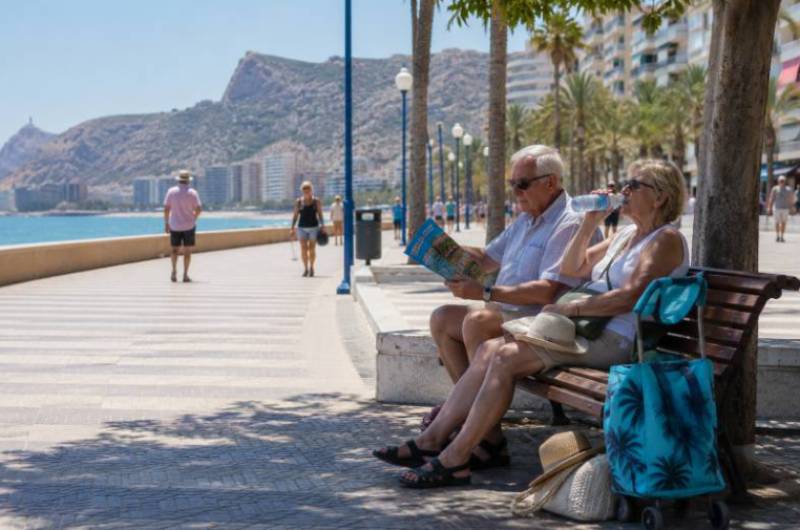
Anyone else spending their time moving from the pool to the air conditioning to the cold shower and back again around a hundred times a day at the moment? Thought so. The Dog Days have officially begun, bringing soaring temperatures, restless nights and another reminder that the hottest part of the year is still ahead of us.
In this week's newsletter, we're taking a look at the latest weather warnings, wildfire concerns, Spain's date with World Cup destiny and the remarkable number of people flying in and out of the country's airports this summer.
So grab something cold to drink, and maybe a large fan, and we’ll dive right in.
Dog days bite back
Wednesday July 15 marked the start of the Dog Days of Summer, the period traditionally associated with the hottest weather of the year. Despite the name, it has nothing to do with overheated pets searching for a cool spot on the tiles.
The phrase dates back to ancient Greece and Rome, when astronomers noticed that Sirius, the brightest star in the night sky and part of the Great Dog constellation, appeared around the same time as the most intense summer heat. In Spain, the period is known as la canícula, a term that comes from the Latin word for "little dog".
Whether you believe the old legends or not, the timing certainly feels appropriate this year.
After a brief lull in some areas, temperatures are once again climbing across most of Spain and forecasters are keeping a close eye on conditions that could develop into another official heatwave by the start of next week.
Large parts of the country are expected to spend the weekend sweltering in temperatures well above 35°C. Inland Andalucía could once again push towards 40°C, while central Spain, the Ebro Valley and parts of Castilla y León are also set for a significant rise.
For anyone in Murcia, the heat is unlikely to offer much respite. Temperatures have already been brushing 40°C across much of the Region and another pulse of hot Saharan air is expected to arrive over the weekend. Forecasters are also warning of hazy conditions, adding to the sticky, uncomfortable feeling that many people have already been experiencing.
Perhaps the biggest challenge will come after sunset, with tropical nights becoming increasingly common and temperatures struggling to fall enough for a comfortable night's sleep.
Across Alicante province, the story is much the same. Inland areas have already been approaching 40°C and the Costa Blanca is heading into another very warm weekend. Coastal breezes should take the edge off the heat in some seaside resorts, but it will remain a case of seeking shade during the hottest hours of the day. By Sunday, there is at least a hint of change on the horizon, with isolated storms possible inland, although coastal areas are expected to remain largely dry.
Andalucía is also seeing temperatures rise again after a short period of relief. Inland provinces remain firmly in the firing line for the highest temperatures, with the Guadalquivir Valley once again among the hottest places in the country. Coastal areas will fare slightly better, but the overall picture remains one of persistent summer heat with very little meaningful rainfall in sight.
With temperatures climbing and vegetation tinder dry after weeks of intense sunshine, wildfire concerns remain firmly in focus.
This week, British Ambassador to Spain Alex Ellis travelled to Almería to meet members of the local British community affected by the devastating wildfires that recently swept through Los Gallardos.
During the visit, he spoke with residents whose homes, businesses and communities have been impacted by the disaster and offered condolences to those affected. Embassy officials explained that consular teams continue to support British nationals and remain in close contact with the Spanish authorities as recovery efforts continue.
The fires hit several areas with significant expat populations, leaving many families facing the difficult task of rebuilding their lives. The Ambassador also met local mayors, emergency services representatives and regional officials involved in the response to the emergency.
The visit served as a reminder that the impact of a major wildfire doesn't end when the flames are extinguished. For many communities, the recovery process can take months or even years.
Over in Murcia, residents in Mazarrón were given an unwelcome scare last weekend when a forest fire broke out in the Sierra de Las Moreras near Bolnuevo.
Although the blaze was brought under control quickly and ultimately affected a relatively small area of scrubland, the timing could hardly have been worse. Coming so soon after the tragedy in Almería, many locals feared a far more serious situation could be unfolding.
Around 20 residents and holidaymakers were evacuated as a precaution, along with people using nearby coves and beaches. More than 100 personnel, supported by aircraft and specialist wildfire crews, took part in the operation.
Thankfully, the fire was declared extinguished by Sunday lunchtime and life has largely returned to normal. Even so, many residents admitted the sight of smoke rising above the hills was enough to bring back memories of recent events elsewhere in southern Spain.
With the Dog Days now under way and another spell of intense heat settling in across the country, the coming weeks are likely to test both residents and emergency services alike.
For now, the advice remains the same as every Spanish summer: stay hydrated, avoid the midday sun where possible and keep a close eye on wildfire warnings, especially in rural and forested areas.
>>> Get more weather insights about Murcia here or join our Facebook groups: Murcia Weather Watch and Spain Weather Watch <<<
¡Vamos España!

The countdown is on.
By the time Sunday evening arrives, bars, restaurants and living rooms across Spain will be packed with fans hoping to see La Roja lift the World Cup trophy.
After a brilliant run through the tournament, Spain now stand just one match away from football immortality as they prepare to face Argentina in what promises to be a nail-biting final.
For many British expats living in Spain, there was one dream scenario that would have topped even this. A Spain v England final would have guaranteed bragging rights in households, friendship groups and local bars up and down the country.
Sadly, it wasn't to be.
England's hopes ended in heartbreaking fashion at the semi-final stage, leaving Spain and Argentina to battle it out for football's biggest prize instead. But that disappointment for England supporters hasn't dampened the excitement here. Far from it.
Across Spain, attention is already turning to Sunday night. The match will dominate conversations in cafés, bars, offices and beach chiringuitos over the next few days. Whether you've followed every minute of the tournament or only tune in when silverware is at stake, there’s no escaping the excitement.
Argentina arrive with their own hopes of making history and few people are expecting a comfortable evening. Finals rarely follow the script and Spain's supporters know better than anyone that football has a habit of keeping nerves shredded until the very last whistle.
Still, after everything this team has produced over the past few weeks, there's a growing belief that Sunday could be one of those nights that people talk about for years afterwards.
For now, the flags are out, the drinks are chilling and the countdown is well and truly on.
¡Vamos España!
Full flights, one fright

At this stage of the summer, there can't be many people left who haven't either waved goodbye to visiting friends and family at the airport, collected guests arriving for a holiday or got someone due to land over the next few weeks.
Judging by the latest figures, they're certainly not travelling alone.
Spain's airports are enjoying another exceptional year, with passenger numbers continuing to climb across the country and several major hubs already breaking records before the summer season has even reached its busiest point.
Alicante Airport has sailed past the 10 million passenger mark after recording its busiest June ever. More than 2.1 million travellers passed through the Costa Blanca gateway last month alone, putting it firmly on course for another record-breaking year.
British visitors continue to dominate international arrivals, with more than 700,000 passengers travelling between Alicante and the UK during June. Given the number of expats, holidaymakers and second-home owners who regularly move between the two countries, that's unlikely to surprise anyone.
Murcia's Corvera Airport has enjoyed one of its strongest years since opening, with passenger numbers rising by more than 10% during the first half of 2026. The airport recently celebrated Ryanair's three millionth passenger and has added new routes to Venice and Lille as demand continues to grow.
Andalucía is seeing a similar boom. Málaga Airport welcomed more than 13.2 million passengers between January and June and even broke the 100,000-passenger mark in a single day for the first time in its history. Seville has also been celebrating, recording its busiest June ever and posting growth figures well above the national average.
Taken together, the figures paint a picture of a country that remains as popular as ever with overseas visitors. Despite soaring temperatures and economic uncertainty across parts of Europe, people are still choosing Spain in huge numbers.
Of course, when millions of passengers are taking to the skies every month, most flights pass entirely without incident. That's why the experience of passengers travelling from Alicante to Liverpool last week has attracted so much attention.
What should have been a routine Friday evening flight turned into a terrifying ordeal when Ryanair flight FR9887 encountered severe turbulence around an hour after leaving Alicante.
Passengers described scenes of panic as the aircraft suddenly lurched and dropped, with some claiming people and cabin crew were thrown from their seats and struck the ceiling. Drinks, bags and personal belongings were sent flying through the cabin as frightened travellers tried to make sense of what was happening.
Several passengers later spoke of screams, tears and a feeling that the situation was spiralling out of control. One compared the experience to a horror film, while another said the memory continued to replay in their mind days later.
The aircraft ultimately diverted to Nantes in western France, where emergency services were waiting on the ground. Ryanair confirmed the flight had encountered turbulence and arranged a replacement aircraft to complete the journey to Liverpool.
Thankfully, the plane landed safely and those requiring medical attention received treatment.
For the millions of people arriving in Spain this summer, airports are likely to mean the start of a holiday, a family reunion or a few weeks in the sunshine. For the passengers on flight FR9887, however, this was one journey they won't be forgetting any time soon.
Murcia

The way households pay for their rubbish could look very different over the next decade if a new regional waste strategy gets the green light.
Under proposals contained in Murcia's new Recircula Horizonte 2035 plan, councils would be encouraged to move away from flat-rate bin charges and gradually introduce systems that link costs more closely to the amount of waste each household produces.
The idea is basically that residents who recycle more and generate less general waste could ultimately pay less than those who throw everything into the same bin.
Murcia currently generates more than 750,000 tonnes of household waste every year, yet only around a quarter of it is eventually recycled. Regional officials believe far too much recyclable material is still ending up in general waste bins, making the process more expensive and less efficient.
Alongside possible changes to bin charges, the plan includes investment in new recycling centres, biodegradable waste treatment facilities, used cooking oil collection and smarter waste management technology.
An internal report backed by six senior officers within Murcia's Fire and Rescue Consortium has raised serious concerns about staffing levels, ageing equipment and emergency response times across the Region.
The document paints a troubling picture of a service that some officers believe is struggling to keep pace with growing demands. Among the issues highlighted are shortages of firefighters, heavy reliance on overtime, ageing vehicles and concerns about equipment used for everything from flood rescues to wildfires.
The report claims some firefighters are working more than 100 hours of overtime each month to help keep stations operational, while certain emergency incidents are taking longer than recommended response times.
There are also concerns about training, communications systems and firefighter safety following incidents involving hazardous smoke exposure.
Management at the consortium strongly disputes the report's conclusions.
CEIS manager Carmelo Cabañero says significant investment is already being made to strengthen the service, pointing to a growing budget, new recruitment drives and ongoing improvements to infrastructure and equipment.
The contrasting accounts have left two very different versions of the situation emerging, and the debate is unlikely to disappear anytime soon, particularly following a summer that has already seen devastating wildfires elsewhere in southern Spain.
Talking about protecting the future of the Region naturally brings us to one of Murcia's most remarkable conservation success stories.
Half a century ago, spotting a Mediterranean monk seal along parts of the Murcian coast wasn't unheard of.
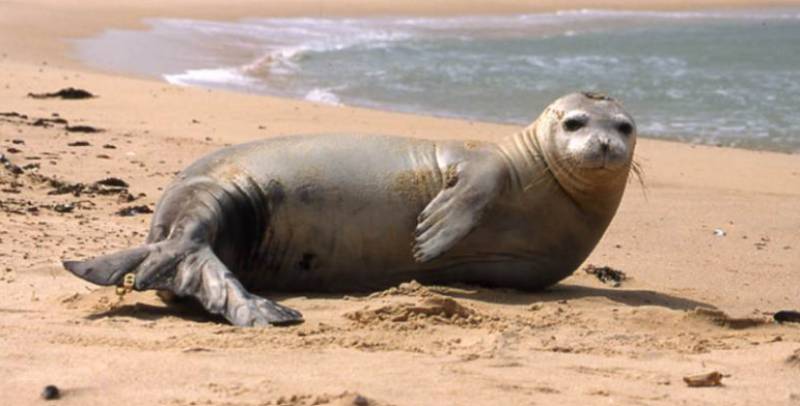 Today, the species is one of the rarest marine mammals in the world, but a new government-backed study is exploring whether the seals could eventually make a return to Spanish waters.
The Ministry for Ecological Transition has commissioned a detailed assessment into the feasibility of reintroducing monk seals, working alongside partners in Portugal, Morocco and Mauritania.
Nothing is happening anytime soon. Officials stress that years of scientific and environmental studies would be needed before any reintroduction could be considered. Even so, conservationists believe Murcia could play an important role.
Environmental groups point to stretches of coastline around Cabo Cope, Calnegre, Cabo Tiñoso, Mazarrón and Cabo de Palos as some of the best-preserved habitats remaining on the Spanish mainland.
The idea might sound ambitious, but Murcia has already proven what can happen when wildlife is given a helping hand.
Over the past six years, almost 300 loggerhead turtles have been released back into the Mediterranean after hatching or receiving specialist care through conservation programmes based in the Region.
Murcia has also become one of the most important nesting areas for loggerhead turtles in the western Mediterranean, with two-thirds of all turtle nests recorded in Spain this year found on Murcian beaches.
For conservationists, it's a sign that nature can recover when the right conditions are created. And perhaps one day, that recovery could even include the return of the Mediterranean monk seal.
There's also plenty happening around the Region of Murcia over the next few days. Sunday July 19 is the last chance to see El Prado en las Calles in Santiago de la Ribera. The free open-air exhibition features 50 large-scale reproductions of masterpieces by artists including Velázquez, Goya, El Bosco and El Greco, bringing one of Spain's most famous art collections to the shores of the Mar Menor.
 Food lovers might prefer Cartagena's first-ever coastal Tapas Route, which runs until Sunday July 19. Bars and restaurants in Islas Menores, Mar de Cristal and Playa Honda are serving up their own takes on classic Spanish tapas, giving visitors the perfect excuse to explore a different stretch of the Mar Menor coastline.
For live music fans, Los 40 Summer Live arrives in Águilas on Friday July 17. One of Spain's biggest summer concert tours, the free event promises a lively evening of chart hits and festival atmosphere by the sea.
To see any events coming up soon in the Murcia area, have a look at our EVENTS DIARY:
Spain

It's been a scorcher of a week in more ways than one, and nowhere is that more obvious than on people's electricity bills. Staying cool this summer is costing Spanish households more than it ever has before. Back to back heatwaves have pushed demand for air conditioning to record levels just as electricity itself has become significantly more expensive, and the two together are shaping up to make this the priciest summer on record for keeping the house liveable.
Several things have combined to push prices up. VAT on electricity is back to 21%, the Electricity Tax has climbed to 5.1% now that the tax breaks linked to the conflict in the Middle East have ended, and wholesale prices spike every time a heatwave hits, since that's precisely when millions of households switch their air con on at once.
During the most recent peak, wholesale prices topped €100 per megawatt hour while parts of the country hit close to 43°C.
The OCU (Organisation of Consumers and Users) found the average household bill had already reached €66.08 a month before the hottest days had even arrived, and it only gets worse from there.
According to the IDAE (Institute for the Diversification and Saving of Energy), every degree you drop the thermostat below the recommended 26°C adds roughly 7% to 8% to your consumption, so a unit costing around €30 a month at 26°C could cost €38 to €40 at 22°C.
The appliance matters too. A fan run for eight hours a day for a month costs as little as €1.80 to €2.60, while a split inverter air con unit runs to €22 to €39, and a portable unit up to €56.
There is a workaround worth knowing. Mario Fernández, CEO of Camby, pointed out that pairing a fan with air conditioning set to 27°C gives the same comfort as air con alone at 24 to 25°C, while cutting costs by 15% to 20%. It's also worth checking your tariff. The OCU found a third of Spanish families are paying for more power than they actually need, in some cases adding up to €450 extra a year for exactly the same supply.
Keeping cool responsibly is one thing, but staying safe on the roads this week is another matter entirely, and the DGT has plenty to say about that too.
The agency has launched a week-long campaign targeting alcohol and drug use behind the wheel, running from Monday July 13 until Sunday July 19, with the Guardia Civil intensifying checks nationwide alongside regional and local police covering urban routes.
The numbers are hard to ignore. Alcohol was present in 28% of all traffic accidents recorded in Spain in 2024, and was responsible for 273 deaths. Fatalities involving a driver who tested positive for alcohol rose 9% compared with the previous year, and 24% compared with 2019. Of all deceased drivers who underwent toxicological analysis in 2024, 34% tested positive for alcohol and 16.4% for drugs.
Spain's points-based licence system has helped bring road deaths down from nearly 4,500 a year to under 1,800 over two decades, but drink and drug driving remains stubbornly persistent. As the DGT's National Road Safety Observatory director Álvaro Gómez put it, "Although progress has been made in raising public awareness about the risks of driving under the influence, scientific evidence shows that the only safe blood alcohol level while driving is zero."
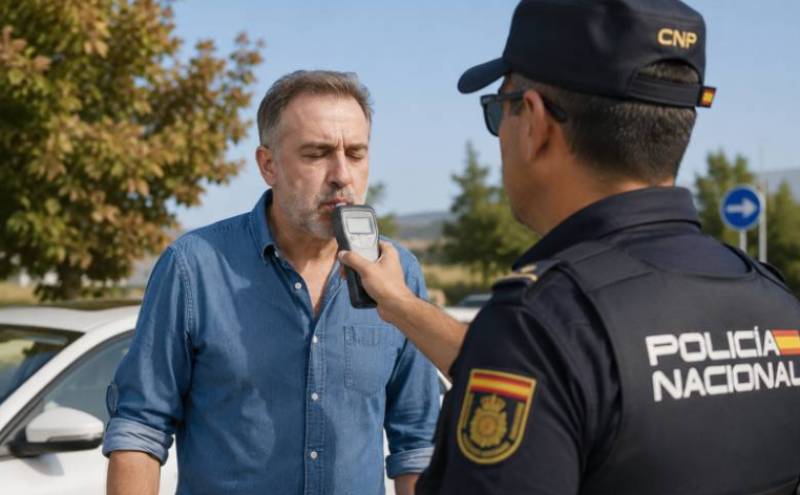 The risk climbs sharply too: at 0.5 g/l the chance of a collision doubles, at 0.8 g/l it's five times greater, and at 1.5 g/l it's twenty times higher than driving sober.
This year's campaign has an unusual human element, with volunteers who have spinal cord injuries from traffic accidents accompanying officers during checks in several provinces, under the slogan "Don't speed, don't drink... don't change your tyres."
As ASPAYM (Association of People with Spinal Cord Injury and Other Physical Disabilities) president Mayte Gallego explained, "All these campaigns boil down to the same thing: overconfidence that ends up backfiring and can change our lives in an instant, for the rest of our days." Her advice was blunt: "It's important to ask ourselves if we are fit to drive or not, and, when making any trip, to do so with a clear head, without external influences."
If all this talk of heatwaves and hazards has you dreaming of cooler days, you're in luck, because Christmas has technically already arrived. It's only the middle of July, there are just under 160 days to go until the draw but the 2026 El Gordo Christmas Lottery is already on sale.
Loterías y Apuestas del Estado have confirmed tickets are already available, with the draw set to distribute a record €2.87 billion in prizes, some €98 million more than last year. This year's issue runs to 205 series of 100,000 numbers each, seven more than 2026, making a total prize pot of €4.1 billion, of which 70% goes back to ticket holders. A tenth share still costs €20.
El Gordo, the top prize, is worth €400,000 per tenth share, with second prize paying €125,000 and third €50,000. One new touch for this year: every ball in the drum, numbers and prizes alike, will be brand new for draw day.
Loterías president Jesús Huerta marked the milestone, noting this year's draw celebrates 214 years of history. "Only by staying true to our essence and contributing our bit to society will we be able to maintain a lottery that unites us around shared values and that maintains this magic of the draw," he said.
The summer adverts have launched too, both shot in Mallorca and built around the idea that the best dreams are shared rather than kept to yourself, and they're well worth a watch on YouTube.
Alicante
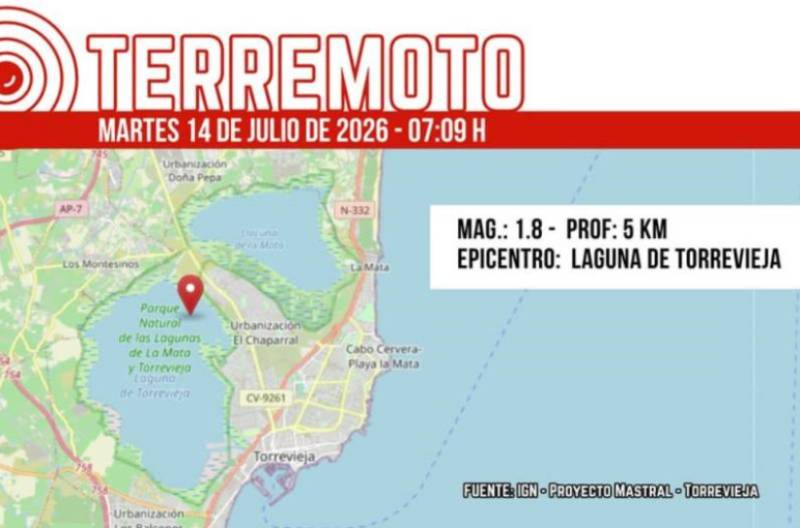
Three small earthquakes in less than 24 hours have given residents across parts of Alicante province something to talk about this week, although none were strong enough to cause any damage.
The latest tremor was recorded near Torrevieja on Tuesday morning, July 14, registering a magnitude of 1.8. According to the National Geographic Institute, the epicentre was located close to the Torrevieja salt lagoon at a depth of 5 kilometres. While relatively minor, some residents reported feeling the ground move, with several sharing their experiences on social media.
The tremor followed two more earthquakes recorded on Monday, one near Elche in the early hours of the morning and another later that evening in the sea between Alicante and Benidorm. Both measured below magnitude 2 and passed without incident.
While the earthquakes caused little more than a brief surprise, a very different story has been unfolding in Torrevieja.
The Guardia Civil is investigating after a body showing signs of violence was discovered at a property in the exclusive La Veleta residential area. The alarm was raised on Friday afternoon after the homeowner reportedly found a bloodied and partially decomposed body in the patio area of the house.
Forensic specialists spent hours examining the scene and the body was later transferred to the Institute of Legal Medicine in Alicante. Sources close to the investigation say an arrest has already been made, although officers have not yet released further details while enquiries continue.
The discovery has shocked residents in one of Torrevieja's most sought-after coastal neighbourhoods, an area better known for its seafront villas than major police investigations.
The case wasn't the only operation keeping officers busy in the south of the province this week.
A man living in Orihuela has been arrested following a joint investigation involving the Policía Nacional and Swedish authorities. The suspect is wanted by prosecutors in Sweden on suspicion of supplying weapons and ammunition to organised criminal groups linked to violent attacks.
Investigators tracked the man to an address in Orihuela, where officers carried out a search and seized several electronic devices that are now being examined as part of the investigation.
According to the Policía Nacional, the criminal networks involved are accused of recruiting young people through social media and paying them in cryptocurrency to carry out attacks on behalf of organised crime groups. Spanish authorities describe these organisations as one of the most serious emerging threats to security across Europe.
The suspect has appeared before a court in Orihuela and the case will now move to the Audiencia Nacional, which will oversee the extradition process requested by Sweden.
Thankfully, not everything making headlines in Alicante this week has involved police investigations and court proceedings.
 One of the world's most famous live entertainment companies has arrived on the Costa Blanca, with Cirque du Soleil's giant blue-and-white big top now standing at Playa de San Juan ahead of the premiere of Kurios: Cabinet of Curiosities.
Getting the enormous structure in place is a spectacle in itself. The tent stands 25 metres high, measures 50 metres across and requires teams of workers inside and outside to coordinate every stage of the assembly process. Once complete, it can accommodate around 2,500 spectators per performance.
The show, which has already attracted more than seven million people around the world, tells the story of a dreamer known as the Seeker, whose collection of strange inventions and curiosities suddenly springs to life. Expect acrobatics, fantasy, imagination and plenty of the jaw-dropping moments that have made Cirque du Soleil famous.
Performances run from Wednesday July 16 until Saturday August 23, giving residents and visitors plenty of opportunities to experience one of the summer's biggest attractions on the Costa Blanca.
Andalucía
Tuesday July 14 was the day the EU and UK finally signed the Treaty on Gibraltar in Brussels, and with it came the news that the border fence separating Spanish and British territory for over a century will come down. Spanish Foreign Minister José Manuel Albares did not mince his words, calling it quite simply "the end of Brexit."
With around 15,000 people crossing daily between Gibraltar and Spain, it is hard to overstate what a practical difference this will make to ordinary life on both sides of the wire.
The agreement, which enters into force the day after signing, has been a long time coming. A UK-Spain pact last September put a breakthrough firmly in sight, an arrangement that was reached in June 2025 and made public in February 2026 after months of detailed work behind the scenes. Physical dismantling of the border infrastructure had already begun on the Spanish side last month. Spain had also been laying the diplomatic groundwork, formally removing Gibraltar from its tax haven list in May after a 35-year designation.
The detail of what has been agreed goes well beyond the fence itself. Spain will take responsibility for border controls at Gibraltar's port and airport, acting as the entry point into the Schengen Area. On residence permits, Gibraltar retains the authority to issue them but must notify Spain in advance, giving Spain 28 days to object on security or public health grounds. On asylum applications, Spain must be informed and has 14 days to raise an objection.
A customs union covering the movement of goods by land will also be established, with Spain overseeing compliance with EU standards. Tobacco gets its own specific provisions too, including a minimum excise tax of €115 per 1,000 cigarettes and duty-free allowances for land travellers set at 200 cigarettes, reduced to 80 for border workers.
It is, by any measure, a comprehensive piece of work. Whether it all beds in smoothly remains to be seen, but for now the mood is optimistic.
From one landmark to another, and Córdoba's Mosque-Cathedral has passed one million visitors for the first half of 2026, the third consecutive year it has hit that milestone before July. The final tally of 1,099,223 is impressive, even if it does represent a 7.35% drop on the same period last year.
The Cathedral Chapter has been pretty candid about the reasons. The Adamuz train disaster and the disruption it caused to the high-speed rail link between Madrid and Andalucía hit hard, particularly in February, when visitor numbers fell by 17.27% year on year. Landslides from heavy rain then disrupted rail connections between Córdoba and Málaga, and a difficult international climate deterred long-haul travellers on top of all that. The monument had already had a turbulent recent history, with a fire, a major restoration programme and a series of bomb threats all featuring in recent months.
Canon José Juan Jiménez Güeto, spokesperson for the Cathedral Chapter, struck a positive note nonetheless. "Surpassing one million visitors again confirms that we remain one of Spain's leading cultural and heritage landmarks," he said. More than half of visitors came from within Spain, with France, the United States and Italy leading the international rankings.
One genuinely bright spot is the Fernandine Churches Route, which bucked the downward trend entirely, attracting 123,799 visitors, a 4.2% increase on last year. Its nighttime opening across seven churches on Thursday, Friday and Saturday evenings in July and August has also made a strong start, with 1,736 visitors in just the first two weekends.

That’s all for this week. Thank you for reading and we’ll see you again for more next Friday.
’Til then!